Menu
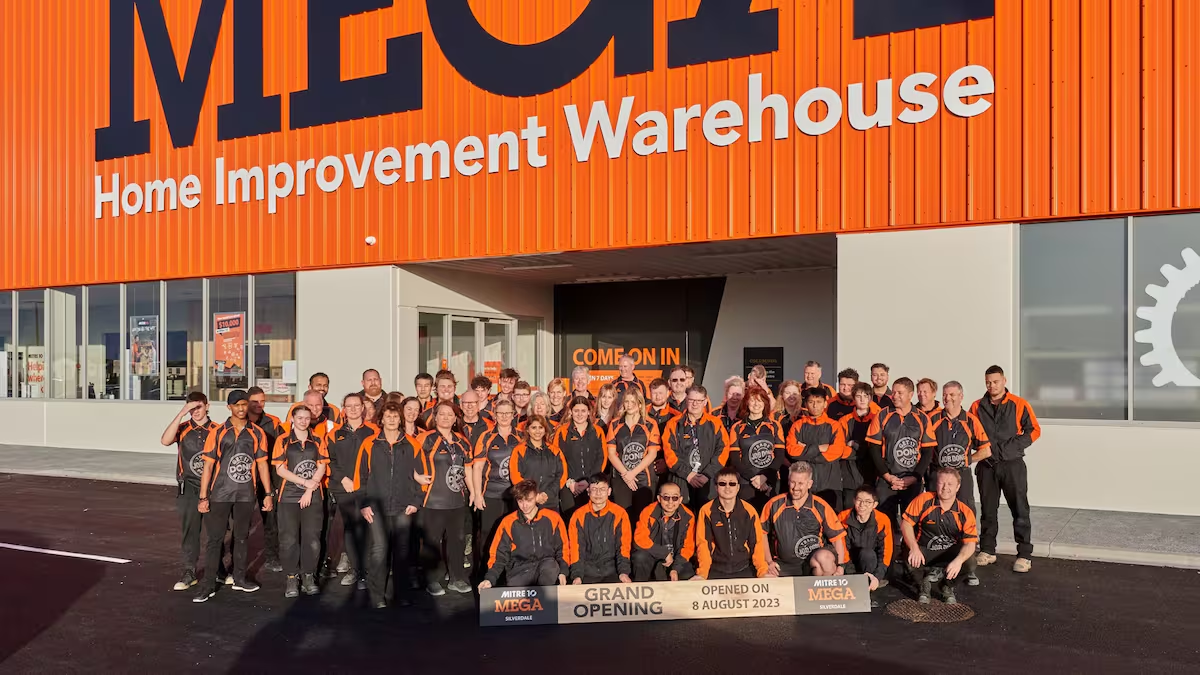
Mitre 10 was partway through the largest transformation in the co-operative's history, and the systems meant to support its people were not keeping up. The learning platform put nine clicks between an employee and a basic module, the learning function was built to produce courses rather than lift performance, and the wider people technology couldn't be relied on for accurate data. The easy path was a shopping trip, a few vendor demos and a signature. Mitre 10 wanted the harder and more useful thing, to understand what their people needed before anyone showed them a screen.
Mitre 10 came to us at the end of 2020 with a decision in front of them. They had a learning platform they'd built in-house, People Hub, developed over years and with real care. The question was whether to keep investing in it, replace it, or rethink the whole approach to people technology sitting underneath it, learning first and then the wider stack.
The easy version of that decision is a shopping trip. Line up a few vendors, sit through the demos, pick the platform with the sharpest screens and the most confident salesperson in the room, sign. Plenty of organisations buy that way and plenty regret it. Mitre 10 wanted something harder and far more useful, to understand what their people needed before anyone showed them a single screen. Everything that worked about this engagement traces back to that one instinct, and to their nerve in holding to it when a demo would have been quicker.
We started with three questions. Was the learning team spending its time on work that mattered to the business? Did it have the capability it needed, and where was it growing? And was People Hub still worth the money going into it?
To answer them, Mitre 10 sent us to the stores rather than the strategy documents. We found a team producing strong material that people on the shop floor couldn't easily reach, couldn't search well, and often had to finish in their own time because stepping away to find a computer was hard. Employees said so plainly. Some managers said the reverse, that people were spending too long on their phones. Mitre 10 didn't look past the gap between those two accounts. They asked us to name it.
The numbers gave it shape. The accepted mix for workplace learning puts around 70% of it in the work itself, 20% in learning from other people, and 10% in formal courses. The team was operating almost entirely in that last 10%, and the format they'd invested most in, eLearning and classroom modules, was the one that employees ranked lowest - below dialogue-based learning for every generation in research covering 10,000 people. Each module took 2 to 3 months to build, but some of the things employees valued more took only 2 to 3 hours.
None of that is comfortable to hear about your own function. Mitre 10 asked to hear it anyway.
People Hub deserved respect, and we said so first. It carried functionality you couldn't buy off the shelf, made by people who cared about it.
Then we were direct about where it let them down. Reaching a simple module took up to nine clicks and then a wait for a manager's approval. Not all content was open to everyone, which quietly limited how people could move sideways into other parts of the business. Keeping it running consumed a real slice of a full-time role, and there was no architecture map or product roadmap steering it.
Our recommendation was to retire a platform they'd built themselves and move to a modern one that could join up with the wider people systems, support learning well beyond formal courses, and lighten the load of running it. That's a hard thing to accept about something you're proud of. Mitre 10 took it on the merits, without defensiveness, because they cared more about what their people needed than about being right about the past.
This is where their instinct earned out. The people technology discovery ran across four workshops and a run of deep dives, and it began nowhere near a product comparison. It began with the employee, every stage of the journey a person travels through Mitre 10, seven of them, from before they're hired to after they've left.
We ran it as proper research and taught the team to run it too, how to interview a user, how to prototype, how to work out what matters most, because a discovery only the consultant can repeat is worth about as long as the invoice.
What surfaced mattered more than any product could. Users, subject-matter experts and leaders each wanted different things, and often hadn't realised how far apart they were until the work made it visible. Working through that difference, rather than papering over it, is slow and uncomfortable, and it's the only way to choose well. The discovery produced sixteen business-critical outcomes, prioritised by the very people who'd have to live with them, with around ninety user stories underneath. Only once all of that was clear did we let a single system be scored against it.
Mitre 10 brought their people into the choice at every level, not only the executives who would sign for it. That's rare, and it changes what a selection process can see.
When we did assess the systems, we mapped the existing tools against those sixteen outcomes, made the gaps plain, and recommended a future shape across applicant tracking, learning and core HR, one that used intranet capability the business already owned rather than paying for it twice. We set out a phased plan, named the runners-up with our reasons for setting each aside, and mapped the integrations between everything.
We also wrote, in black and white, that Five held no partnership or referral arrangement with any vendor we recommended, and was advising independently. It was true then and it's still how we work. When a consultancy resells the licence it tells you to buy, the incentive only ever points one way, and it never points at a smaller deployment. Several of the things we recommended weren't purchases at all. Mitre 10 could trust the advice precisely because nobody in the room was paid by the answer.
Most reviews close with a line like identify a leader to implement the changes, and most reviews then go in a drawer. Mitre 10 asked us to help make the changes real, and we stepped in to lead the learning function through the shift while its new shape stood up.
What followed ran as delivery, not advice. A team vision session in January. A development programme the week after. A new strategy written in early February and taken to the Executive Leadership Team the week after that. A clear-out of the processes, systems and file locations the team had piled up beyond what anyone could keep track of. Then three small products in quick succession, social learning, user-generated content, and facilitation in place of instruction, because the fastest way to change what a team believes is to let them try the new thing once and then do it better.
The function had been two separate teams with a scatter of satellite roles and an external designer filling gaps. It became one team of Learning Experience Partners, with a learning product owner and a shared agile coach. The new structure went live on 22 March 2021, and the team relaunched the week after. Four months from the first question to a working answer, because Mitre 10 wanted it real, not recommended.
If you're weighing up a learning platform, an HRIS, or a wider people technology stack, and you'd rather understand what your people need than sit through another demo, that's the conversation worth having. Get in touch.
Make delivery inevitable.
© 2026 Five New Zealand Limited · NZBN 9429030159006 · Tāmaki Makaurau Auckland
Privacy notice