
The delivery gap: a manifesto
A manifesto for organisations that are ready to make delivery inevitable. Nick Mackeson-Smith, Founder, Five New Zealand.
Opening
The strategy wasn't the problem. It never is.
The problem is the gap between the strategy on the wall and the reality on the floor, between what leaders agreed in the room and what their people experienced the following Monday, between ambition and delivery. I've spent most of my career inside that gap, and I built Five because I got tired of watching it grow.
What I saw that I couldn't un-see
There's a glass of Merlot and a journal that started all of this.
I was reflecting on nearly two years of working alongside a large, capable, well-resourced transformation firm, and I was trying to understand why the experience had been so relentlessly exhausting. Not workload exhaustion. Something deeper than that.
The word that kept appearing in my notes was empowerment. It was used constantly, and almost always to mean the same thing… throw a problem into the void, commit someone to solving it who had neither the knowledge nor the capability to do so, and then penalise them when they couldn't deliver. The dissonance was astonishing, and what troubled me most was that I seemed to be the only one who could see it, or at least the only one not blinded by the gloss and the PowerPoint decks and the sheer confidence of the expertise in the room.
So I wrote an article about it. Not a business plan, not a strategy, just an honest account of what I'd observed and why I believed organisations deserved better. I bought a domain to publish it, built a template website in an evening, made a logo in five minutes in PowerPoint so I could fill in all the fields, and pressed publish. I had no idea what would happen next.
That article resonated with people more than I ever imagined possible, and Five became a reality.
What the experience had shown me, though, was something I couldn't un-see. I'd watched exceptional people, smart, experienced, deeply expert, working in separate corners, each pulling threads with genuine care and none of them with the full picture. I'd watched a technology implementation that worked brilliantly as a system fail completely as a change. I'd watched a culture programme engage people beautifully and have no connection whatsoever to how the strategy was actually being executed. I'd watched organisations spend extraordinary sums on advisory work and end up with solutions in one place that caused problems somewhere else, because nobody was looking at the whole system and nobody was willing to slow down long enough to ask whether the problem they'd been hired to solve was actually the problem worth solving.
That's what Five exists to change.
If you've hired a consultant to solve a problem and found yourself hiring them again twelve months later to solve a version of the same problem, you already know what this document is about. If you've sat in a debrief and felt the gap between what the report said and what your people were actually experiencing, you know. If you've watched a change programme generate enormous activity and very little change, you know. You just might not have had a name for it yet.
The problem with the expert model
Most consulting is built on a model of expertise. You have a problem, we have an expert, the expert arrives, diagnoses, recommends and departs. Next problem.
It's a clean model, and it breaks down in almost every organisation worth working with, because decisions in one domain cascade into others in ways the expert was never asked to consider. A performance system affects culture. Culture affects how strategy lands. How strategy lands affects whether the technology investment pays off. And so on, indefinitely and in every direction, because organisations are whole systems and whole systems don't respond well to being treated as a collection of separate parts.
A few years ago a Chief People Officer asked us to build a competency framework. Our first reaction was… surely you've already got one. Our second was… do you actually need one? Our third, after about ten minutes of searching online, was to find two excellent, publicly available frameworks from their own company's UK and Australian entities, and one created by Standards NZ. All three were superb. All three were free. The work was never to build a framework. It was to understand why nobody had done that search, and then help solve that.
Some would call that anti-business. I'd call it the entire point.
There's also what I'd call the dependency problem, and it's the one that troubles me most. I've watched organisations go back to the same consulting firm after a piece of work fell short of what was promised, not because the work had improved but because the relationship had quietly become load-bearing. Over time, the organisation's own capacity to diagnose and solve its hardest problems had been outsourced along with the work itself. Changing course started to feel riskier than staying. And so the phone gets picked up again, and the cycle continues.
I understand why it happens. Stepping out of a long consulting relationship takes real courage, especially when there's a significant imbalance of power and knowledge, and when the people inside the organisation have been told, directly or indirectly, that the problems are too complex for them to solve alone. But a different approach yields different results. And the organisations I most respect are the ones that found the courage to find out.
I was tired of being part of the other kind.
Sabre Wulf and the art of exploring first
When I was about ten years old, I played Sabre Wulf on the ZX Spectrum. A 256-screen maze with no map, no instructions and no tutorials. You started with no idea how the world was structured or which paths led where, and the only way to make sense of it was to explore. Methodically, patiently, building a picture of the system before you could make any meaningful decisions within it.
A couple of years later I was doing something similar with The Legend of Zelda on the NES. That game had levers. Pull one and then you had to figure out through exploration which door it had opened somewhere in the dungeon, so pulling a lever before you understood the map meant wandering blind, but pulling it after meant knowing exactly where to go and why.
Both games taught me the same thing, and I've thought about it ever since in the context of consulting work. Exploring first doesn't slow you down. It makes every decision that follows faster, sharper and more deliberate. And the moment when you pull exactly the right lever and exactly the right door opens… that's the feeling this work is supposed to produce.
Five pillars. One system.
Delivery rarely falters in just one place.
Strategy may be clear but performance disciplines are uneven, so accountability doesn't follow intent. Capability may be strong but decision-making lacks consistency, so good thinking doesn't become good execution. Technology may be modern but cultural signals pull in different directions, so the investment doesn't stick. These aren't separate problems. They're different expressions of the same underlying misalignment, and treating them separately is exactly how you end up with a solution in one place and a new problem somewhere else.
Our work is organised around five pillars — Strategy and Leadership, Performance, Culture, People and Technology — because these are the areas that most consistently shape whether delivery holds or drifts, and because they only work when they work together.
The sequence matters. We always begin with Strategy and Leadership because shared direction sets the tone for everything that follows, and then Performance to translate that intent into accountability and measures that guide behaviour, and then Culture because culture determines what happens under pressure and pressure is when delivery either holds or breaks, and then People because capability becomes purposeful once direction is clear, and then Technology which strengthens execution when it arrives into an already-aligned environment and creates noise and complexity when it doesn't.
You can't fix delivery by pulling just one of these. But knowing which one to start with, and why, changes everything.
Understanding before intervening
Before we recommend anything, we need to understand the system as it actually is, not as the executive team experiences it, not as the engagement survey reported it two years ago and certainly not as the org chart describes it.
That means understanding what your people are really trying to do every day, not their job titles or their KPIs but the actual jobs they're trying to get done and where they get stuck doing them. It means understanding the gap between what the organisation intends and what people experience, between the values on the wall and the behaviour in the room, between what leadership believes is happening at the front line and what the front line actually encounters.
We call this the intention-action gap, and it shows up in every organisation we work with. It's almost always where the real problem lives, not in the strategy, not in the structure, but in the distance between what the organisation says it does and what people actually experience it doing.
The tool we use to surface this is our own proprietary Organisational System Discovery… interviews, workshops and observational research across employees, managers and the people who shape systems and tools. We map where people succeed and where they get stuck, we surface the hidden drivers of performance that surveys miss, and we build the map.
Without the map, you're pulling levers blind.
Maturity isn't a destination. It's a direction.
One of the things I'm most proud of in the work we've built at Five is our Organisational Maturity Model, and not because it looks impressive in a slide, though it does, but because it gives leaders a precise, shared language for understanding where their organisation actually is and what moving it forward will take.
The model maps six stages across each of the five pillars… Ad Hoc, Experimenting, Empowering, Scaling, Embedded and Relentless Reinvention. Every organisation is somewhere on this spectrum, and most are in different places across different pillars at the same time. The leadership team might be at Embedded while the culture is still Experimenting, the technology stack might be modern while the ways of working around it are Ad Hoc, and that gap between pillars is often exactly where the real drag on performance sits.
What the model gives us is diagnostic precision. Instead of "your culture needs work" which tells you nothing about where to start, we can say exactly where you are, what the specific frictions are that are limiting your performance right now and what needs to shift to move forward, not in the abstract but in practice, with a clear sequence and a shared picture of what good looks like at the next stage.
That's the difference between a programme that generates activity and one that generates outcomes, between change that sticks and change that needs repeating every eighteen months. We've never been interested in the second kind.
From values to outcomes
Most organisations intervene too late in the causal chain, and it costs them enormously.
They see a result they don't want and try to change it directly. Targets change, processes change, sometimes people change, but the result comes back, or something like it does, because the underlying cause was never touched. What determines outcomes isn't the outputs directly. It's the chain that produces them. Values shape beliefs, beliefs shape mindsets, mindsets determine choices, choices drive behaviours, behaviours produce outputs and outputs, accumulated over time, produce the outcomes the organisation either intended or ended up with.
The intervention that lasts is the one that starts at the right point in that chain, and usually that means working at the level of beliefs and mindsets, the place where what the organisation says it values starts to disconnect from what people actually experience it doing. That's a harder conversation than changing a target, it takes longer and it requires honesty about the gap between stated values and lived ones, but it produces change that doesn't need to be repeated the following year because it started where the problem actually lived.
What we're not
The people you meet at Five are the people who do the work. There is no bench of juniors deployed while the partners move on to the next pitch, because we're a small and deliberately built team of people who are masters in their craft and who stay in the engagement because context matters and context is lost the moment you rotate people in and out.
We say no. To work that isn't interesting enough, to clients whose values don't align with ours, to engagements where we'd be treating a symptom rather than solving the problem. And we measure ourselves by one thing… whether the organisation is stronger when we're not in the room than it was before we arrived.
I've seen what consulting looks like when the commercial model takes precedence over the client's interests, and I've been on the receiving end of it. I know what it feels like when a firm optimises for the engagement rather than for you — when the model rewards activity over outcomes, incentivises selling the next engagement before the current one is done, and treats client capability as something to be managed rather than built. I understand how those models develop. There's nothing unusual about them. But that doesn't make them right, and it doesn't make them what I want to be part of.
What making delivery inevitable actually means
Delivery becomes inevitable when the conditions for it are right, and that's what the phrase means. Not a guarantee, but a shift in the odds so significant that the outcome stops depending on heroic individual effort and becomes the natural result of how the organisation operates.
Those conditions are straightforward to describe and difficult to create. It starts with leadership that's aligned and making clear decisions, so that when direction shifts, people understand why and know where to point their effort. It requires a culture that actively supports the behaviours execution demands, rather than one that quietly undermines them. It needs people who have both the capability and the clarity to do their jobs well, not one without the other. It depends on performance systems that measure the things that matter and create accountability that's proportionate and fair. And it asks that technology supports the work rather than adding a layer of complexity on top of it. When those five things are pulling in the same direction — not perfectly, not finished, but aligned — delivery stops being personal and becomes systematic.
Most organisations I encounter are doing remarkable things with inadequate conditions, and the people inside them are working incredibly hard to compensate for systems that weren't designed to support them. Leadership managing complexity that a clearer structure would eliminate, culture held together by relationships and goodwill rather than by design, delivery that looks systematic from the outside and is entirely personal from the inside.
That works for a while, and then it doesn't, and the organisations that thrive over time are the ones that choose to do the harder, slower work of getting the conditions right. That's what Five is in the business of creating, not a single transformation, but a sustained and systemic capacity to deliver reliably, at pace, without burning out the people doing it.
A final word
I started Five with a straightforward conviction. Organisations deserved better than surface-level advisory work, and the people inside them deserved better than being managed through change rather than involved in it.
That conviction hasn't changed.
People often ask about the name and whether we want to be the fifth of the Big Four. We absolutely don't. There are only five Mackeson-Smiths in the whole world as far as I know, and my family is the reason I do this work. To set an example of what good work looks like. To show what care and selflessness in business can actually do. To have the freedom to choose how and where and with whom we work. Business is relational, and Five is relational, and our clients know that… they talk about their families just as often as they talk about their challenges, and that's exactly how I want it.
I've seen many times over what becomes possible when an organisation truly understands its own system, when it knows where it is, when it knows which levers to pull and why and in what order, when it has the clarity to be deliberate rather than reactive. The delivery gap is real and it costs organisations money and momentum and the trust of their people, but it's not structural and it's not inevitable and it doesn't have to be permanent.
It's a solvable problem. You just have to be willing to understand the system before you start pulling levers.
If any of this has felt familiar, if you've recognised your organisation somewhere in these pages, or felt the particular exhaustion of carrying a system that was never designed to support you, then you already know what the first conversation looks like. It starts with curiosity, not a proposal.
And after everything that glass of Merlot set in motion, I can't imagine doing anything else.

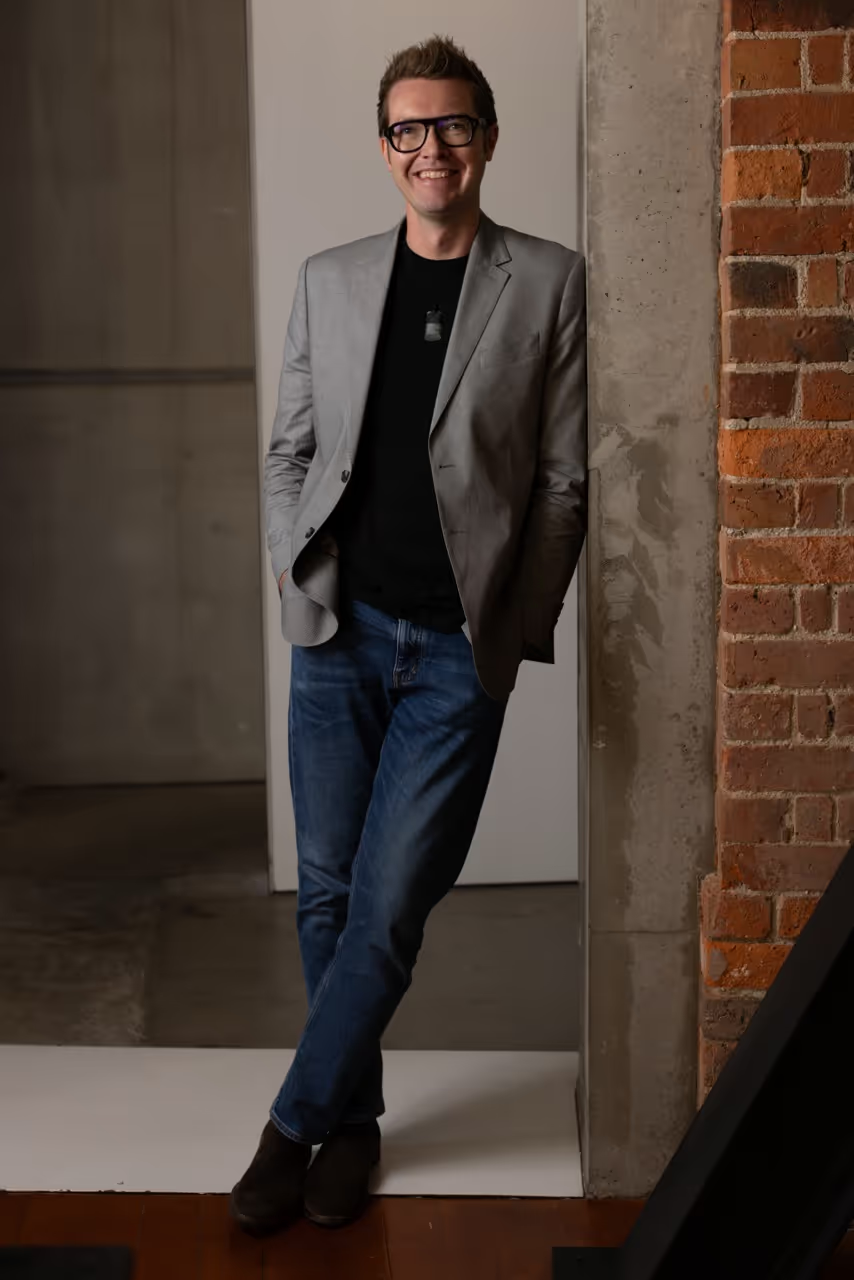
Who to talk to at Five
Related services


Make delivery inevitable.
© 2026 Five New Zealand Limited · NZBN 9429030159006 · Tāmaki Makaurau Auckland
Privacy notice