
Nobody can tell you what your potential is

I was kicking this around with someone a couple of days ago and we ended up stuck on the thing I always get stuck on, which is the vertical axis of the talent grid.
The horizontal one is alright. Performance. You can argue about how well anyone actually measures it and you’d be right to, but at least everybody agrees it’s describing something that already happened. Then there’s the other axis, where we ask a manager to rate somebody’s potential... a guess about a future that hasn’t turned up yet, made by a person who has to sound confident saying it out loud in a room full of their peers.
And then we plot them. That dot decides who gets the secondment, who gets a sponsor, who gets the development budget, and who gets asked into the room where the next interesting thing gets decided.
So the rating goes off and makes itself true. Rate someone high and they get the work that stretches them. Rate someone low and they get more of what they can already do. 18 months later the grid looks spot on and everyone congratulates themselves on how well they know their people.
That’s the bit that bothers me. Not that the judgement is hard, because it is, and I’d rather people made hard judgements than dodged them. It’s that the judgement is load-bearing and nobody in the room can tell you what it’s made of.
What we’re actually measuring
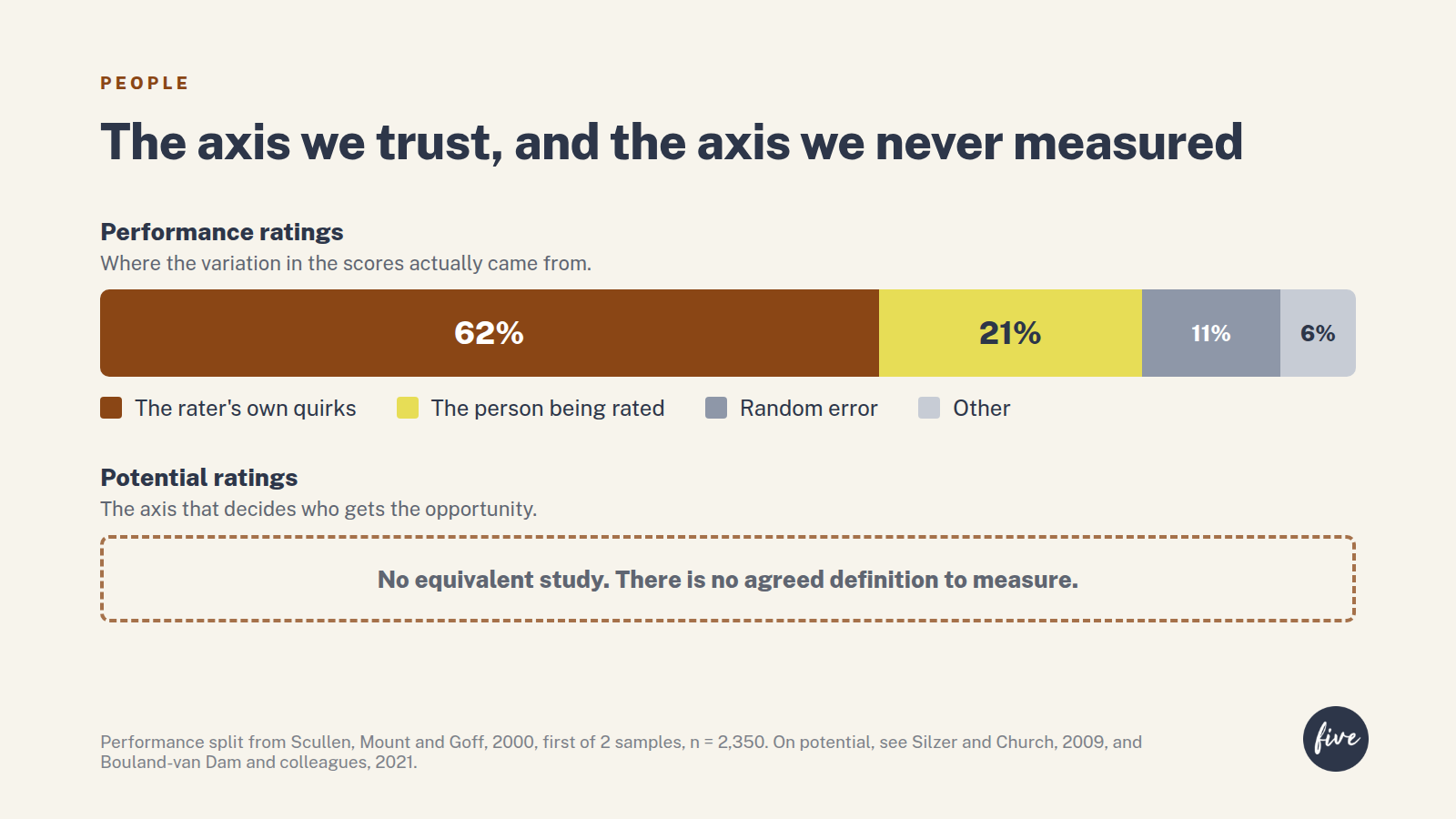
There’s a study where a few thousand managers were each rated by 7 different people. When the researchers pulled the numbers apart, more than half of the variation in the scores came down to the personal quirks of whoever happened to be holding the pen. Everything to do with the person being rated was only about 1/5 of it. Madness!!! And that’s performance. That’s meant to be the axis we’re comfortable with - the one where the thing being rated has actually happened.
Then there’s the definition problem. Somebody went and looked at how a group of big, well run companies define potential, Boeing and Dell and HP and Southwest Airlines in the States among them, and not one of them defined potential in the same way. A recent review of the whole research field described the state of it as a "hot mess" of conceptual and measurement problems, which feels about right to me.
So with potential, we’re taking a word that nobody seems to be able to define clearly, and then measuring it with an instrument that mostly reflects whoever’s using it, and then using the answer to hand out the opportunities that decide who gets good at what.
MADNESS!!!
The grid was built for things that can’t read it
The 3 by 3 came out of a McKinsey job at GE that started in 1968, and the matrix that came out of it around 1970 rated business units on industry attractiveness against competitive strength so a sprawling conglomerate could work out where to put its cash. Who first pointed it at human beings I genuinely can’t find out, although everybody assures you it happened. I was taught about it in my very first job at Barclays Capital, and told how effective it was. Who was I to question that at the young age of 20 in my first career role?
Two axes you can point at
If potential is a guess rather than a quantifiable property, then making a better guess isn’t the fix. We need to replace the prediction with a record of fact. Here’s what I think instead we should be measuring in order to have effective and valuable talent conversations.
The first axis is what they delivered. Not a rating out of 5 and not an impression of how the year felt, but the measures that were agreed at the start and what actually moved. The uncomfortable part is that you’ll find a lot of roles where nobody ever agreed an outcome in the first place, and honestly, finding that out is worth more than the grid ever was. Fix that before you map your talent.
The second axis should be what they give to the organisation beyond their own team, and I think this is the one that matters the most. To do this well, there are 4 things I’d want evidence of.
- What do they know that we’d struggle to replace, and are they sharing it or sitting on it?
- Who is measurably better at their job because of them?
- Do they work across the organisation or only inside their own bit?
- Do the behaviours they model make it easier for other people to perform, including people who don’t report to them?
Both of those have already happened. You can point at them, and the person can see what you’re pointing at.
Make the bet out loud
There’s still a call to make about where you invest, and pretending otherwise would be daft, so make it in the open.
Rather than quietly deciding somebody is a high potential and then directing the good work their way, name the stretch, say what success looks like, put it on the table and let people put their hand up for it. Sponsors can still tap someone on the shoulder and tell them to go for it. The difference is that the opportunity isn’t being rationed by a list that nobody is allowed to see.
That will turn potential into an experiment instead of a judgement. You’re placing a bet with a stake and a timeframe and an agreed measure, and when you review it, you’re reviewing the bet. Someone who doesn’t land it hasn’t been exposed as a lesser human. They’ve had a crack at something hard and you’ve both learned something specific about what they’d need next time - and then you celebrate their effort and go again.
Most organisations already know their talent process is uncomfortable, and the usual response is to tighten up the calibration session, add a psychometric, write better behavioural anchors for the potential scale. All of which is getting more precise about a guess.
Stop rating potential. Record what people have delivered, record what they give the place beyond their own job, and make the investment decision a bet you’re willing to say out loud in front of the person it’s about.


Who to talk to at Five
Related services


Make delivery inevitable.
© 2026 Five New Zealand Limited · NZBN 9429030159006 · Tāmaki Makaurau Auckland
Privacy notice