
The 5 questions every board must ask before approving an AI budget
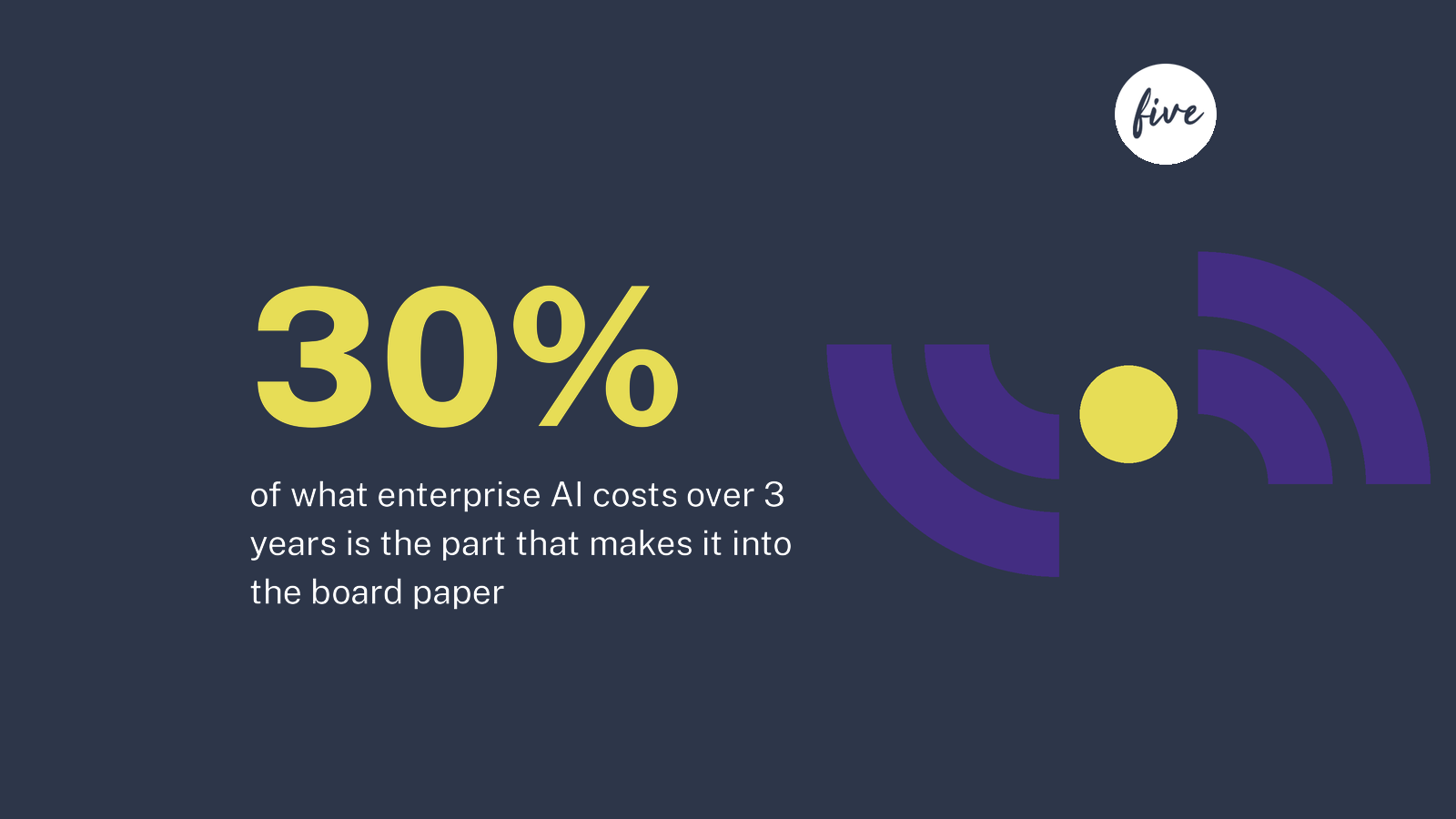
Most AI budgets that reach a board cover about a third of what the thing will actually cost.
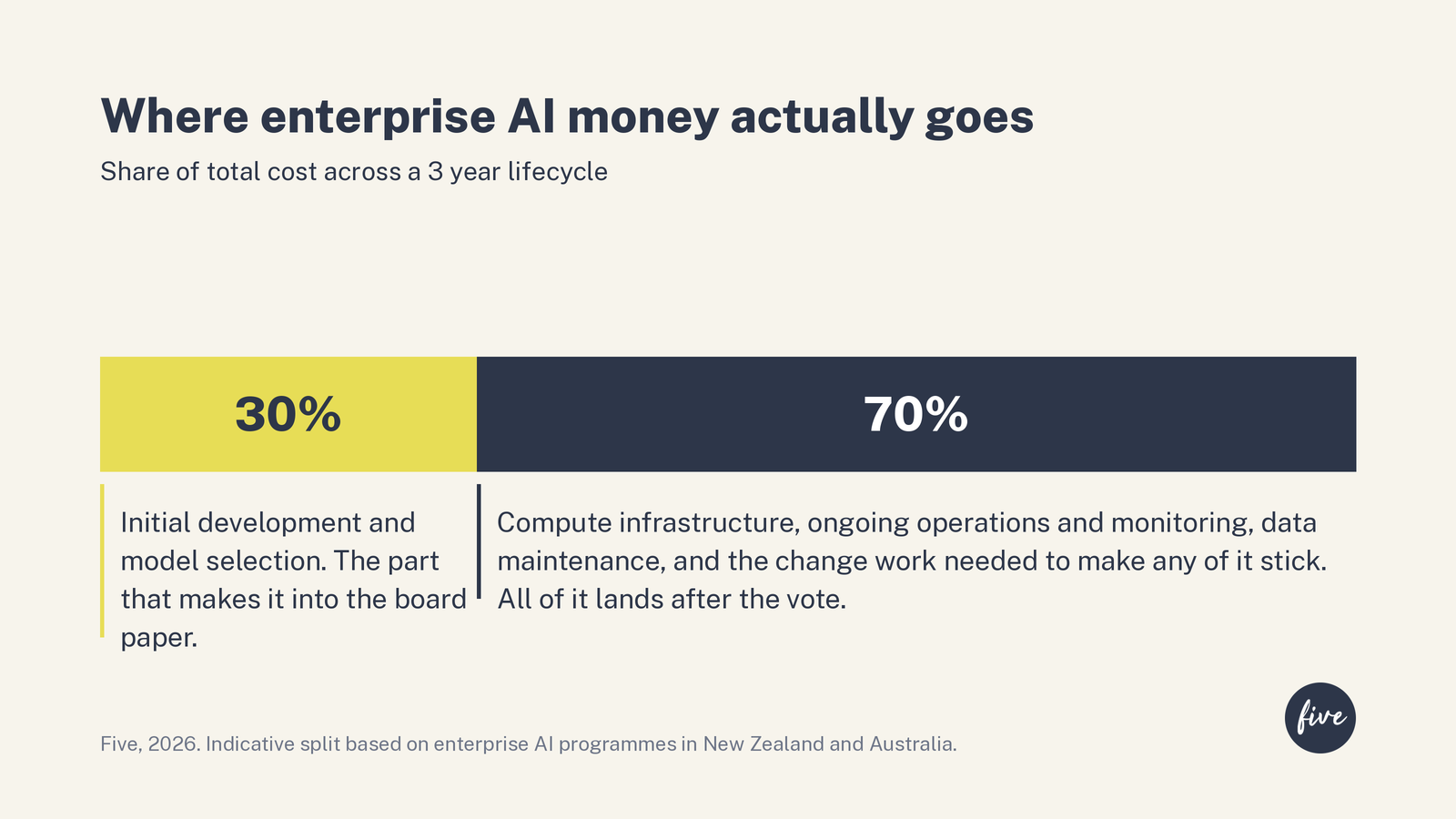
The build is the part that makes it into the paper. Model selection, development, the pilot. It’s also the cheapest part, and the only part that finishes. Compute, monitoring, data maintenance and the change work that gets people actually using it all land later, and they don’t stop.
What the research actually says
Gartner predicted that 30% of generative AI projects would be abandoned after proof of concept by the end of 2025, and pointed at poor data quality, weak risk controls and unclear business value as the reasons. RAND puts the failure rate for AI projects above 80%, which is twice the rate of IT projects that don’t involve AI.
RAND’s researchers interviewed 65 data scientists and engineers to work out why, and landed on 5 root causes. Only 1 of them is the technology being immature. The other 4 are leaders failing to communicate what problem they want solved, not having good enough data, technical teams chasing the newest tools instead of the business problem, and underinvestment in infrastructure.
Those are governance and management failures. Every one of them is settled long before a model gets deployed.
The gap in the room isn’t technical
Sitting across from boards in New Zealand and Australia, the thing that stalls AI work isn’t a lack of ambition. There’s plenty of that.
It’s that directors disagree about AI and nobody has said so out loud. One sees an existential threat. Another sees a line item. Most of that distance comes down to how thin AI literacy still is in the room, and you can’t agree on how much risk you’re willing to take when you haven’t agreed on what you know and what you don’t.
So the risk appetite never gets set. The budget gets approved anyway, because saying no to AI feels like the riskier vote.
5 questions worth asking before the vote
These take about 20 minutes and they surface the disagreement while it’s still cheap.
- What business problem are we solving, and is AI the simplest way to solve it?
- Do we own the data this needs, and is it clean enough to trust?
- What will this cost us over 3 years, not just to build?
- What happens when it fails, and who picks up the work?
- Given what we don’t know, how much risk are we actually prepared to take?
Question 5 is the one that gets skipped, and it’s the one that makes the other 4 answerable. A board that hasn’t agreed its risk appetite is deciding the same question over and over, in a slightly different form, every time a new proposal lands.
Approve the whole thing or don’t approve it
A board that says yes without asking these has approved the 30% it can see and hoped the rest sorts itself out. It rarely does. The other 70% turns up as budget variance, a stalled rollout, or a capable model nobody uses.
Ask the questions before the vote, not at the first review. And if the answers land differently around the table, that’s not a delay. That’s the work.
If your executive team isn’t aligned on risk and priorities, that’s the blocker worth fixing before the next proposal arrives. We built AI Compass to help leaders close that gap, assess where they actually are, and build a measurable path from proof of concept to production.


Who to talk to at Five

Related services


Make delivery inevitable.
© 2026 Five New Zealand Limited · NZBN 9429030159006 · Tāmaki Makaurau Auckland
Privacy notice