
We've given them the tools
“We’ve given them the tools.”
It gets said in steering committees with a kind of finality, as though the sentence closes the matter, and everybody around the table nods, because on paper it’s true. The licences are bought, the rollout happened, the training deck went out, the intranet page exists. The tools are, in the strictest sense, there.
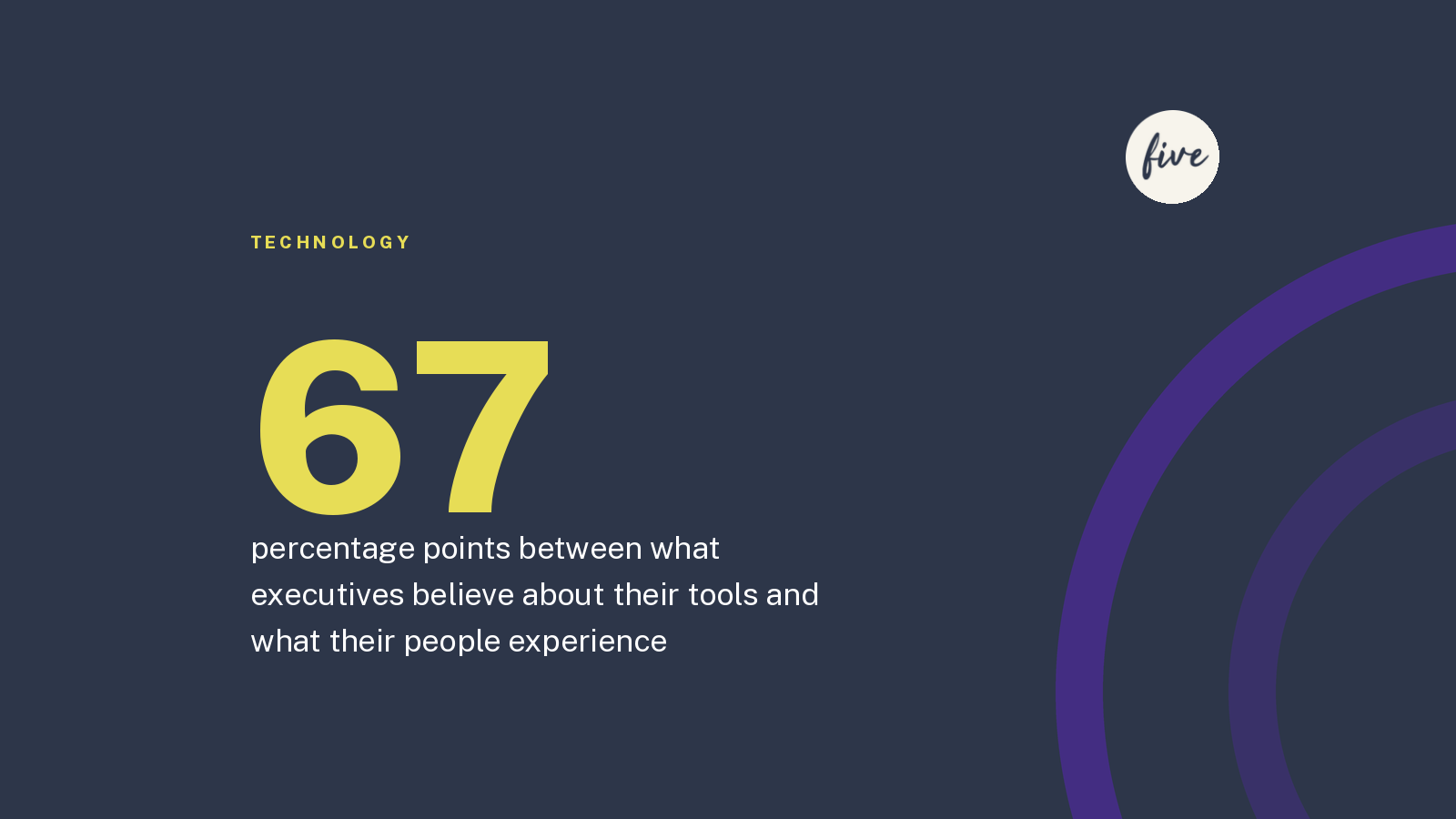
WalkMe published their 2026 State of Digital Adoption report in April. They surveyed 3,750 people across fourteen countries, seventeen hundred of them senior leaders, all in organisations of a thousand people or more. Buried in it is a number I keep coming back to. 88% of executives are confident that their people have adequate tools to do their jobs. Of the people actually doing those jobs, 21% agree.
Sixty-seven percentage points is a big enough gap that you have to stop calling it a difference of emphasis and start accepting that the two groups are describing different organisations, despite working in the same building and logging into the same systems.
There’s a second one that’s nearly as wide. 61% of executives say they trust AI to handle complex, business-critical decisions, against 9% of the workforce, which is a fifty-two point gap on a question where the executives are the ones further from the actual output. Meanwhile the report puts the cost of the friction at 51 working days per employee per year, up 42% on the previous year’s number.
Don’t get me wrong, I’m not about to argue that executives are stupid or that they don’t care, because in my experience they usually do care rather a lot, and they are typically the ones who fought for the budget in the first place. The question that interests me is how somebody who genuinely cares ends up sixty-seven points wrong about their own organisation.
Where does a sixty-seven point gap actually come from?
I’ve written before about how knowledge moves through organisations, and how the further up you go the more it has been filtered, polished and shaped by the people carrying it, often to serve an agenda, personal or otherwise. Software adoption might be the purest example of that I can think of, because the information that reaches an executive about whether a system is working arrives as a completion percentage, an attendance figure from the training sessions, a green status on a slide, and a licence count, and every one of those can be perfectly accurate while the underlying experience is miserable.
Nobody in that chain is lying, and I want to be clear about that, because the programme manager reported exactly what was asked of them, which was whether the rollout had finished, and it had. Whether the process is now being followed correctly by the people who have to do it several times a day is an entirely different question, and typically nobody has been asked to measure that one, so nobody does.
So the executive believes 88%, because the evidence they have been handed says 88%, and the 21% never reaches them in a form they can act on. It reaches them as a grumble in a corridor, or an engagement survey comment they can’t attribute to any particular system, or a resignation.
What if we measured the middle?
What if the question we asked after go-live wasn’t whether the rollout completed, but how many steps it now takes to do the thing? What if we counted how many forms come back for rework, and compared that to the number before? What if we knew which of our applications people quietly avoid, and which ones they open every day, and what we’re paying for the ones nobody touches? What if the executive team saw the same number the frontline experiences, rather than a translation of it?
None of that requires a new philosophy or a new framework, it requires somebody deciding that the measure exists before the thing being measured, and then holding to it when the programme gets busy and the reporting quietly reverts to percentage complete.
I believe the gap closes if we agree what good looks like before we build anything. It closes if the people doing the work are the ones who define the friction. And it closes if we keep measuring after go-live, when the programme funding has stopped and everyone has moved on to the next thing.
That last one is where nearly every programme I’ve seen comes unstuck, because go-live is where the money runs out, and the measurement was never funded separately in the first place.
A practical place to start
If you want a sense of your own gap, you don’t need a survey of 3,750 people, you need one afternoon and a handful of honest questions asked of the people who use your systems most.
- How many clicks to ____
- How often does ____ come back for rework
- What do you have open on a second screen because ____ doesn’t give it to you
- Which system do you avoid using, and what do you do instead
- Who do you ask when ____ goes wrong
- What did we train you on that you’ve since stopped doing
- Which report do you produce that nobody reads
Then take the answers to the same executives who scored 88%, and watch what happens. In my experience they don’t get defensive, they get interested, because for the first time somebody has handed them something they can actually do something about.
This is the work we do at Five, over ServiceNow, nCino, Workday, Dynamics, Salesforce and SAP, mostly in banks and mostly in places where the process genuinely has to be followed correctly. We’ve been WalkMe’s partner in New Zealand since 2019, and since the referral programme ended in September 2024 we’ve made nothing on the licences, which means we’re as happy telling you to shrink your estate as we are telling you to extend it.
Go and ask the seven questions above. Write the answers down without softening them, and then put them in front of the person who believes the number is 88%.
You cannot fix a gap that nobody has been asked to measure.


Who to talk to at Five



Related services


Make delivery inevitable.
© 2026 Five New Zealand Limited · NZBN 9429030159006 · Tāmaki Makaurau Auckland
Privacy notice